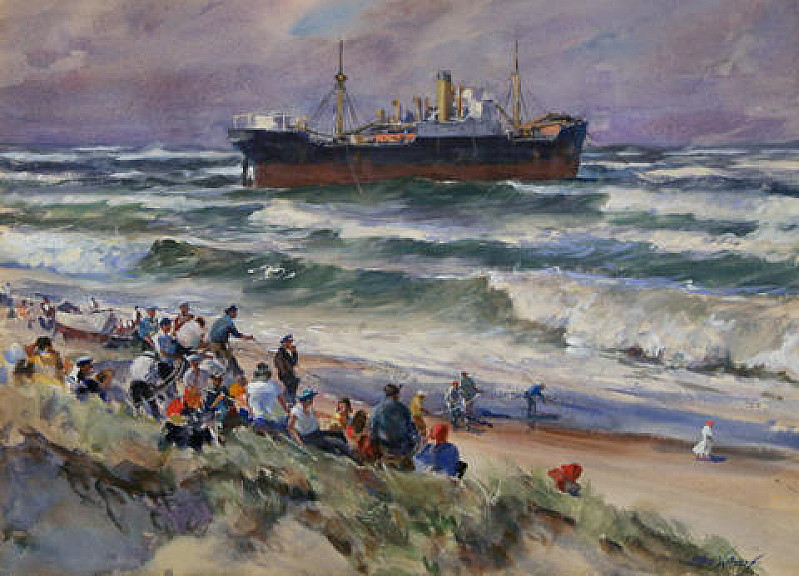
- The Eugenia Aground
- Whorf, John
- 1953
- watercolor
- SLR
- 22 x 30 inches
John Whorf, NA.: (1903 - 1959) Studied with his father, Harry C. Whorf, and at Botolphe Studio with Sherman Kid, 1917, also BMFA with Wm. Hale and Philip Hale and in Provincetown with Charles Hawthorne, Max Bohm, Richard Miller and George Elmer Browne, Gerrit Beneker and E. Webster, plus others here and in Paris. Also studied with John Singer Sargent in Boston, 1925. Member of: ANA, NA 1947, AWCS, The Beachcombers and PAAM. Exhibits include: WCS 1934 and 39, AIC in 1934 (prize), WMAA, BMFA, Watercolor Society, Brooklyn Museum, WCC, NOMA, and numerous others, most with prizes or medals. Works at: MoMA, BMFA, WMAA, BMA, BM, LACMA, MIT, Fogg, MA., Addison Gallery, AIC, RISD, CAM, also in Stockholm, Sweden, Pitti Palace, Florence Italy and many others. Very well listed and accredited with an NA (National Academy - highest distinction for an artist).
Bio note from American Art Analog: John Whorf is considered by some to be one of the greatest American watercolorists. He used the medium to transcend realism and infuse his subjects with atmosphere and emotion. He moved to Provincetown at age 14 and studied under major artists. At age 18, he wandered through France, Portugal, and Morocco, constantly painting and occasionally returning to Paris for brief study. During this time, Whorf began painting with watercolor, having previously worked only in oils.
Watercolor was better-suited, Whorf thought, to his peripatetic life, and also to capturing the subtle blend of natural colors and the elusive play of shadow and light. In 1924, Whorf had his first one-man exhibition at Boston's Grace Horne Gallery. More than 50 of his paintings were sold, and he was heralded as Boston's leading watercolorist. Until his death, Whorf would be exhibited in New York City and Boston galleries. In 1947, he was elected a member of the National Academy of Design. Although Whorf traveled throughout his life and painted street scenes, cities, people and mountains, his freshest inspiration always seemed to come from the Cape Cod landscape. He ultimately settled in Provincetown, where he died in 1959.
"The Eugenia Aground" also known as "The Eugenia Aground with a Crowd on the Beach" and "Eugenia Runs Aground, North Truro", dated 1953, watercolor, 22 x 30, Signed Lower Right, Excellent Condition, Paul Goodnow gold frame.