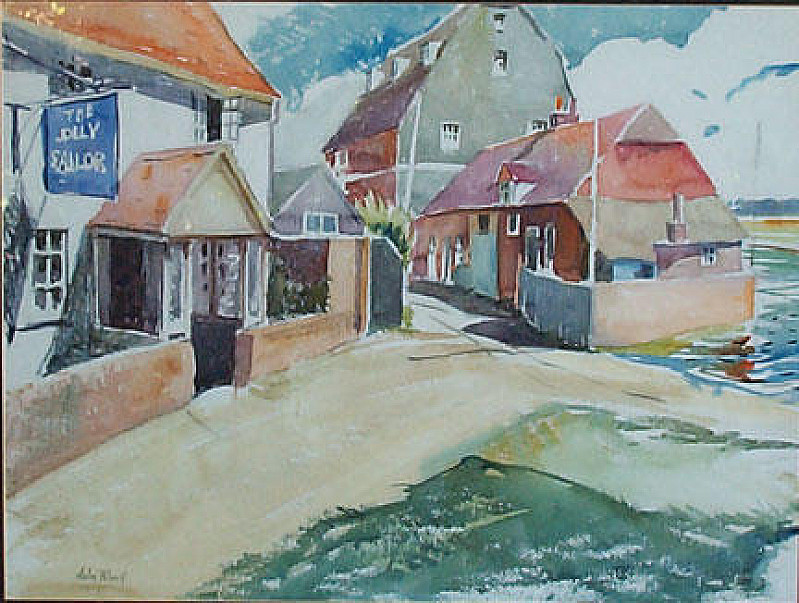
- Jolly Sailor
- Whorf, John
- watercolor
- SLL
- 20 x 30 inches
John Whorf, NA: (1903 - 1959) Studied with his father, Harry C. Whorf, and at Botolphe Studio with Sherman Kid, 1917, also BMFA with Wm. Hale and Philip Hale and in Provincetown with Charles Hawthorne, Max Bohm, Richard Miller and George Elmer Browne, Gerrit Beneker and E. Webster, plus others here and in Paris. Also studied with John Singer Sargent in Boston, 1925 (Who's Who in American Art says 1925-26, but John Singer Sargent died in 1925). Member of: ANA, NA 1947, AWCS, The Beachcombers and PAAM. Exhibits include: Grace Horn Gallery, Boston, 1924 (first solo show), WCS 1934 and 39, AIC in 1934 (prize), WMAA, BMFA, Watercolor Society, Brooklyn Museum, WCC, NOMA, and too many others to list, most with prizes or medals. Works at: MoMA, BMFA, WMAA, BMA, BM, LACMA, MIT, Fogg, MA., Addison Gallery, AIC, RISD, CAM, also in Stockholm, Sweden, Pitti Palace, Florence Italy and many others. Very well listed and accredited with an NA (highest distinction for an artist).(This painting has a very indistinct tear in the middle of the painting. It can be restored but one has to get very close to the painting to find the tear. Tear is approximately 7 inches and very clean.)FROM ASK ART: This biography was submitted by Spanierman Gallery, LLCJohn Whorf was one of the most accomplished and esteemed watercolorists of the first half of the twentieth century. Creating realist depictions of urban and rural imagery, he worked in a luminous painterly style often compared to that of John Singer Sargent and Winslow Homer.Born in Winthrop, Massachusetts, Whorf received his initial exposure to art from his father, Harry C. Whorf, a commercial artist and graphic designer. His first formal instruction began, however, at age fourteen when he enrolled simultaneously at the St. Botolph Studio in Boston, where he was taught by Sherman Kidd, and at the Boston Museum School, where his teachers were Philip L. Hale and William James. Spending the summer of 1917 or 1918 in Provincetown, Whorf attended a class with Charles W. Hawthorne, a popular teacher who rendered portraits and landscapes in a bold and painterly style. The Cape Cod landscape had a deep effect on Whorf and he would return to render it continuously throughout his life. He was also attracted to Provincetown's growing art colony, and during his first stay he met such leading contemporary painters as Max Bohn and E. Ambrose Webster. About 1919, Whorf visited France, Spain, Portugal and Morocco. In Paris, he enrolled briefly at the Ecole des Beaux-Arts, the Grande Chaumière, and the Académie Colarossi. During his time abroad, Whorf turned increasingly away from oil painting and began to focus on watercolor, which he found suited his transient lifestyle and his expressive and aesthetic interests. Whorf returned to Boston during the early 1920s. In 1924, his first solo exhibition was held at the Grace Horne Gallery. The show was extremely well received; fifty works were sold, and Whorf was commended as Boston's leading watercolorist by the press. His paintings also captured the attention of John Singer Sargent, who purchased a watercolor from the artist. Whorf claimed that following his successful debut, he received informal instruction from Sargent. Throughout the rest of his career, Whorf remained a popular and prolific artist. He exhibited his work annually at Grace Horne in Boston and at the Milch Gallery in New York; during the summers, he showed at the Shore Galleries in Provincetown. He depicted landscapes and figural works, however, he is best known for his city views which have been compared to those of Edward Hopper and Reginald Marsh for their realistic approach. Yet Whorf's fluid technique reflects the more painterly styles of Sargent and American Impressionist Frank Benson. He developed a confident and spontaneous method of applying his paint, creating works in which he interspersed sparkling transparent washes with areas of deep opaque color.Although he often traveled in America and abroad in search of painting subjects, Whorf and his wife Vivienne settled in Provincetown in 1937. There the artist painted landscapes and figural subjects, and continued to enjoy a successful career. He was one of two contemporary Massachusetts artists represented in the Museum of Modern Art's 1938 exhibition of American art created in Paris. In 1947, he was elected a member of the National Academy of Design. This biography was submitted by Pierce Galleries IncWhorf, JOHN National Academician (American, 1903-1959):John Whorf is considered one of the finest American watercolorists from the early 20th century and his style was most influenced by John Singer Sargent. Whorf was born in Winthrop, MA in 1903 and died in Provincetown in 1959. He studied with his father Harry C. Whorf; at the St. Botolph Studio in Boston with Sherman Kidd at the age of 14; at Boston's Museum School with William James and Philip Leslie Hale in 1917; and in Provincetown after 1917-1918 with Charles W. Hawthorne; with Max Bohm, Richard Miller, Garrett Beneker, George Elmer Browne and E.A. Webster in Provincetown; and in Paris after 1919 at the Academy de la Grande Chaumiere, the Ecole des Beaux Arts and the Academie Colarossi and with John Singer Sargent in Boston as late as 1924-1925.Whorf was an Associate and a full Academician of the National Academy of Design (1947) and a member of the American Water Color Society; the Florida Water Color Society; The Beachcombers; and the Provincetown Art Association. He was given his first solo exhibition in 1924 at the Grace Horne Gallery in Boston and the Milch Galleries in New York gave him 32 solo exhibitions. Awards include medals the California Water Color Society; Art Institute of Chicago (1939, 1943) and an honorary M.A. from Harvard University in 1939. The artist's work is represented at Museum of Fine Arts (Boston); Metropolitan Museum of Art; M.I.T.; Fogg Art Museum; Addison Gallery of American Art; Amherst College Art Museum; John Herron Art Institute; Museum of Modern Art; Los Angeles County Museum; Worcester Art Museum; Montclair Art Museum; Art Institute of Chicago; R.I. School of Design; Corcoran Gallery of Art; St. Louis Museum of Art; Butler Art Institute; National Museum, Stockholm, Sweden; Pitti Palace, Florence, Italy; Yale University; Baltimore Museum of Art; and more.This biography was submitted by Stephen B. O'Brien Jr. Fine ArtsIn a preface to Whorf's 1997 show at the St. Botolph Club in Boston Massachusetts, Amy Whorf McGuiggan makes the following observation regarding John Whorf's success: "If there was a secret to the popular appeal that Whorf enjoyed in his day it is that he reminded people of everyday scenes, taking his viewers along with him to sun-drenched Moroccan bazaars, on strolls along slushy Boston sidewalks, for a moonlit sailing party on Provincetown Harbor or up a mast to reef a sail during a northeaster. The critics of the day were no less enthusiastic, citing Whorf's technical proficiencies, his bold washes, provocative color, balanced design and forceful play of light and shadow."Whorf was born in Winthrop, Massachusetts, to parents who encouraged his early talent. At age 14 he was enrolled to study painting at the Boston Museum School and with Sherman Kidd at the St. Botolph Studio. He also studied with Charles Hawthorne at the Cape School in Provincetown, John Singer Sargent, and later took training at the Ecole Colarossi and the Academie des Beaux-Arts. At age 21, Whorf held the first of his thirty-five successive annual one-man exhibitions, two each year. After recovering from a paralyzing accident at age 18, Whorf left for Europe where he painted throughout France, Portugal, and Morocco. From 1924 on, he was a highly regarded watercolorist. Whorf married Vivienne Wing in 1925 and became the father of four children. He and his family lived in Brookline spending summers in Provincetown until 1937 when they relocated permanently to the lower Cape. Whorf's work owes a great debt to his teacher, the master Charles Hawthorne. His watercolors employ a boldness and depth of color usually associated with oil painting which he learned from Hawthorne.Whorf earned memberships in the National Academy and National Watercolor Society. In 1938, Harvard College conferred on Whorf an Honorary Master of Fine Arts. His work is in major collections including the Metropolitan Museum and Museum of Modern Art in New York City.------------------------------------------------------------------------This biography from the archives of AskART.com.A native of Boston, John Whorf became a noted watercolorist of a wide range of subjects. During the Depression years in Boston, he was one of the few artists whose work continued to sell.He was descended from a long line of Cape Cod ship captains, and his father was an artist and graphic designer. He studied painting at the St. Botolph Studio and the Museum of Fine Arts School in Boston. At age 14, he went to Provincetown and worked with Charles Hawthorne, and then at age 18 had a paralyzing fall from which he had difficulty recovering. Initially he painted in oil, but changed to watercolor. His first exhibition of fifty-two paintings, when he was age twenty, sold out. He traveled in Europe and the United States, but ultimately established his studio in Provincetown.Credit: David Zellman, "300 Years of American Art"